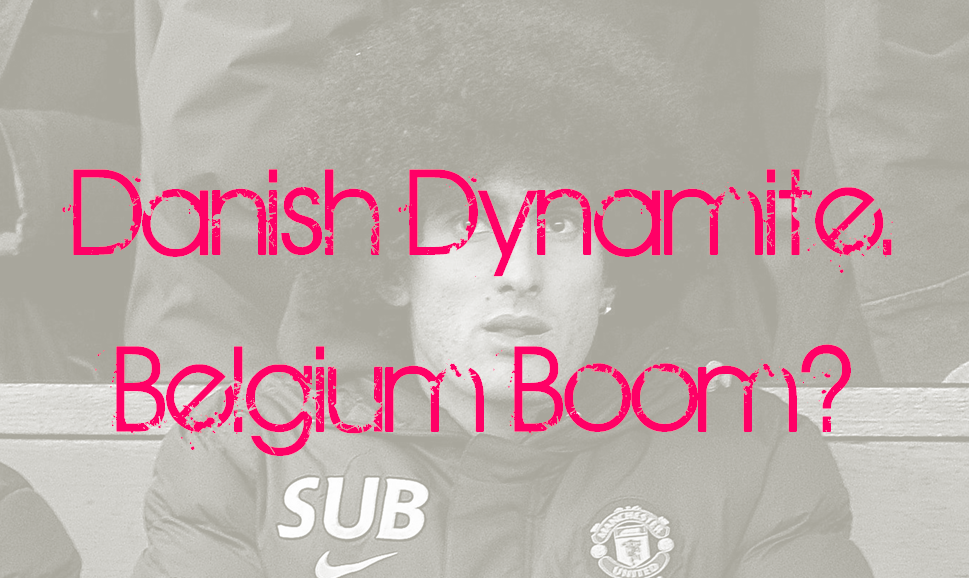
The Belgium national squad is an exciting place to be these days. It is home to a swathe of talented players prominent at Europe’s biggest clubs and led by a national footballing icon. Youthful and exuberant with proven quality, tipping them to perform this summer would hardly be risking anyone’s reputation. Their fresh and eclectic image draws parallels with Denmark’s rockstar side of the mid-eighties. Although Sepp Piontek’s much fancied Vikings never truly delivered that which they promised and Marc Wilmot’s charges of 2014 are currently a long way behind the Laudrup, Elkjear and Lerby vintage at the same stage of Euro 84 or Mexico 86. Belgium have it all to prove.
Stunned, Wembley fell silent in disbelief. Allan Simonsen fell to his knees, fists clenched and eyes wide, ecstasy plastered across his face as he was mobbed by his jubilant teammates. The heart of the Denmark side in 1983 had just coolly converted an unerring penalty that would ultimately signal the end of England’s Euro 84 qualification hopes while simultaneously catapulting the Danes to the forefront of Europe’s collective footballing consciousness.
This night had been coming, and for longer than England had suspected. On the face of it a group containing Piontek’s men, Greece, Hungary and perennial whipping boys Luxembourg was an evidently winnable one. However, unbeknownst to the English public, across the North Sea a Viking horde had been gathering strength for some time. A 3-1 away friendly demolition of eventual Euro 84 winners France earlier that year had manager England Manager Bobby Robson sounding the alarms.
Sir Bobby’s vociferous warnings made few waves with the haughty English press and fan base. This was despite England sharing four goals and the points in Copenhagen earlier that campaign. A magical run and finish from future Manchester United forward Jesper Olsen had sent the on-looking Danish masses into raptures. This result had amounted to one of the most impressive competitive displays in Denmark’s professional history, before being promptly superseded by the return fixture.
This history was, at the time however, a decidedly short one, as much of Danish football had long been strictly amateur based. The emergence of paid football had been delayed until the late seventies, forcing Denmark’s talent to disperse themselves through a number of European leagues early in their careers. Although, the Dane’s goalkeeper Ole Kjaer, who made a crucial late reflex save from a spinning Luther Blissett, remained in his homeland and would have to hurry home to his day job at a local sports shop in Esbjerg after the match.
German coach Piontek would steer his side to the semi finals in 84, only to lose to Spain on penalties after lanky striker Preben Elkjear’s Chris Waddle-like effort in the shoot-out. A ball, Michael Laudrup, 19 at the time, jokes, they are still looking for. Laudrup had just signed for Lazio where he joined fellow Dane in Serie A, forward Klaus Berggreen who was on Pisa’s books while Jesper Olsen and future Liverpool midfielder Jan Molby played their football for Ajax. Another 8 members of a precociously talent squad were dotted around Belgium and Germany, including Soren Lerby at Bayern Munich and Elkjear himself, who was destined to get the goals that would propel Hellas Verona to an unprecedented Scudetto in 1985. While 1977 Ballon d’Or winner Simonson, who would tragically suffer a horrific leg break early on in the 84 opener against host nation France, had just returned home (via a brief, and rather odd, stint at Charlton Athletic) from Barcelona where he had scored another crucial goal, this time to win the 1982 Cup Winners Cup.
Denmark’s quality on the eve of the tournament was as hard to ignore as Elkjear’s swaggering stride or Soren Lerby’s flash of yellow hair. This summer, Marc Wilmot’s Belgium side find themselves harbouring similar confidence heading into Brazil and like Piontek’s men they too are cast around Europe, gathering glory of their own in some abundance. Thibaut Courtois, fresh from an utterly remarkable La Liga triumph and Champions league final run with Atletico Madrid, is arguably the best goalkeeper on the planet – his talent evermore otherworldly when you consider he’s still only 22, inspirational captain Vincent Kompany led Manchester City to their second league crown in three years, while Romelu Lukaku, Eden Hazard and Kevin Mirallas greedily gobbled up the Premier League goals this season, accruing 37 between them. Not to mention that Toby Alderwireld, Axel Witsel, Kevin De Bruyne and Marouane Fellaini have each commanded substantial 8 figure transfer sums in the last 18 months.
Individually their credentials are undeniable, and the tag of fifth favourites with book-makers behind the South American giants, Spain and Germany would, on the face of it, seem to be a rational one. But why? Surely the faith placed in them is without cause? When Russia’s Fabio Capello is handed a team sheet on June 22nd and sees Hazard, Januzaj and Mertens, fear may well strike, but what have Belgium the team done to deserve such respect and admiration? Belgium lack a moment resembling Denmark’s Wembley triumph in September 1983. When have their collective rallied together to overcome and thus proving their abilities as a fearsome group rather than simply touting individual accomplishments? Laudrup’s bewitching pace and trickery, Morten Olsen’s stoic pride and forthright defending, Soren Lerby’s shinpad-less power and aggression, Simonson’s calming guile and precision all came together to usurp England, home and away, and to stun the French. They were a fully-fledged team heading into Euro 84, and a better one than England, are Belgium?
The Brazilian excursion will be Belgium’s first major tournament for 14 years when Wilmots himself captained the side into the last 16 in 2002 before being abruptly halted by eventual winners Brazil, thanks to a deflected Rivaldo drive and a Ronaldo effort that squeezed between the legs of hapless keeper Geert de Vlieger. The current generation’s standout performance came via a 4-2 friendly win over Holland. A game played just after Euro 2012 against a humiliated Dutch side bedraggled by three abject performances in Poland, fielding a youthful team who crumbled late on. A win in Croatia to help qualification was important, no doubt, but to progress at the world cup you have to beat the big teams and that victory over The Netherlands is their solitary triumph against the traditional big 9 nations (England, Italy, France, Holland, Germany, Spain, Portugal, Brazil, Argentina) for over a decade.
Are Hazard, Kompany and Courtois world class players? Yes. Is their squad deep enough to handle the hussle and bustle of a major international tournament? On paper, certainly. Is Wilmots an inspirational figure? For sure. But why should we believe in them? For now, they’re Tottenham – a host of potentially exciting individuals thrown together in the hope that they can eventually reproduce previous performances. Although this is often the case for teams looking for momentum in the intermittent international game, but there is still little evidence that ties on the pitch have become binding. Sepp Piontek’s Danish side had already shown the world they could compete with the elite as a group when their golden generation entered the fray; it’s time for Belgium’s to do the same. It’s a little overdue.
 In Acres of Space